

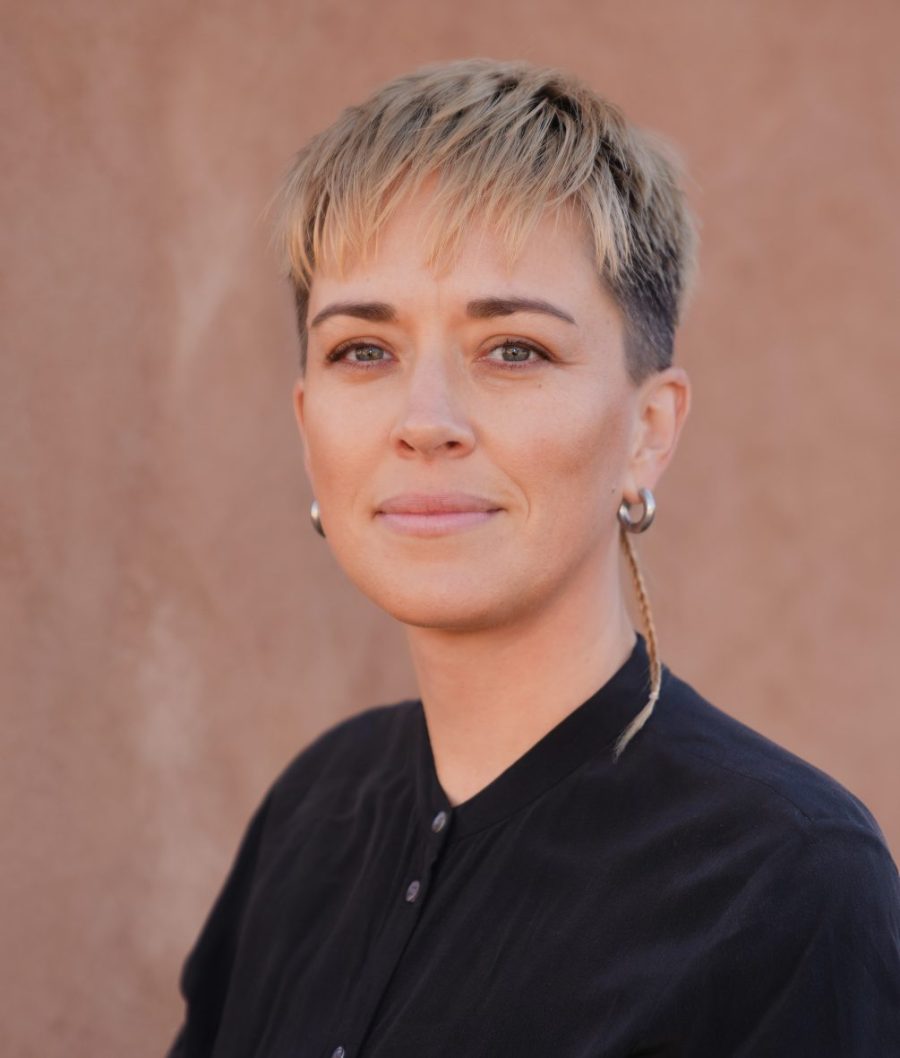
Alexandria Bombach: Close-up portrait of a person with short, textured blonde hair and darker roots, wearing small hoop earrings and a black collared shirt, looking calmly at the camera against a warm-toned background.
Interview with Alexandria Bombach
What does receiving an unrestricted grant at this particular moment make possible within your practice? Has it shifted the way you are thinking, working, or planning for what comes next?
Receiving an unrestricted grant at this particular moment has felt like a true gift of time. It created space for me to think more expansively and act more intentionally across all of my projects, rather than constantly operating reactively or in survival mode. With that space, I completed a fundraising proposal to build a documentary filmmakers’ residency in Santa Fe, NM. I’ve also begun writing a micro-budget narrative film centered on trans lives, and have created written and visual materials for my next documentary project with a level of care and depth that would have been impossible otherwise. Just as importantly, the grant has allowed me to give back to my community, and show up in ways that aren’t tied to compensation. I had the opportunity to take behind-the-scenes photographs for a friend’s stage reading of a play depicting a trans Mexican healing journey, and to offer story consulting to a first-time feature filmmaker working with archival material from the Nakba in Palestine. Overall, it’s shifted how I think about sustainability and possibility in my practice. Instead of only planning for the next immediate step, I’m able to invest in longer-term visions and build toward what comes next with discernment and intention.
How is your practice responding to, reflecting, or pushing against the current cultural and political moment?
My practice is rooted in storytelling and supporting storytellers, and right now that work is vital in directly pushing against the rise of fascism globally. Across my practice I’m using storytelling to challenge dominant narratives, make space for truths that are often erased or suppressed, and offer catharsis and imagination for another way forward. The documentary filmmaker residency I’m building centers rest with dignity as a core value and explicitly recognizes and confronts the need for an anti-capitalist intervention in an industry that equates worth with productivity. Creating a space for marginalized truth-tellers to rest, restore, and create outside of extractive systems feels both urgent and necessary in this moment. My scripted narrative work focuses on offering catharsis for trans communities while we witness the early stages of genocide against trans people in the United States. The film is about how we survive this moment with radical joy and connection with our neighbors. The film’s values are reflected in its making by bringing together a collective of queer creatives to shape the process and story. My upcoming documentary interrogates how white supremacy shapes our understanding of conservation, land, and invasive species by examining the histories and ideologies that continue to determine what it means to belong, and who gets to decide.
Collective care is central to Threewalls’s work. How does that idea take shape in your own practice or community right now, and what are you hoping to build, sustain, or imagine moving forward?
Collective care, in my practice, is about supporting my artist community in Santa Fe, the filmmakers I consult with internationally, and my creative collaborators. It’s through my leadership as a director and my holistic story consulting that I center rest and reflection as a vital part of the creative process. I am eager to bring these same values into the residency I’m building. Collective care is essential to making this work sustainable as we push up against capitalist narratives that inflict burnout and isolation. I also know that in order to show up for my community I must show up for myself, so that what I offer is rooted in genuine reciprocity rather than depletion. At a time when many of the systems the film industry once relied on are eroding or losing funding, we’re being asked to imagine new ways of working and supporting one another. Collective care, to me, is the foundation of that future, and it’s something we must build together.


Leave A Comment