

Ellington Robinson Interview
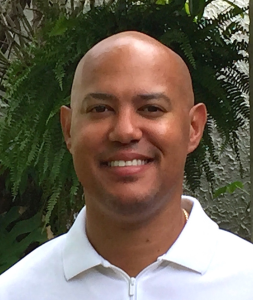
Portrait of a bald man smiling at the camera, wearing a white collared shirt, standing outdoors in front of green foliage.
What does receiving an unrestricted grant at this particular moment make possible within your practice? Has it shifted the way you are thinking, working, or planning for what comes next?
Receiving a grant at this moment made it possible to offset expenses in preparing for my latest solo exhibition Place Time- Marronage. It confirmed my process in thinking, working and planning. The exhibition visit by Dr. Jeffreen M.H. Ash, accomplished that trifecta through our discourse and her recommendation of books to expand my scope of the work and introducing me to writers who are thinking deeply on the same subject matter. The nurturing and firm stance on excellence is the personal appeal that helps to push the practice to a boundless evolution. Thus, the exhibition visit can be considered an extension of the grant. This is germane to the Three Wall mission of being “itinerant.” In addition, the impetuous of the awarded grant is a surreptitious observation of the artists from Three Walls. It is a declaration of appreciation, without fanfare, that the recipients are in alignment with the values of the organization. It is a nudge, maybe a jolt to the artist, to keep keeping on and to share it.
How is your practice responding to, reflecting, or pushing against the current cultural and political moment?
My practice leading up to the current exhibition provided a body of work that unintentionally but intensely parallels the current geo-political climate. The theme of mountainous landscapes as a place for maroonage: decolonization; detoxification; a hiatus from technology; a refuge from intellect and a sanctuary for BEing’. The work attempts to answer the call for colored people around the world who are subjugated to these constant vicissitudes of the imperial system. Simultaneously, the forms of the mountainous dendrite fractals reverberate in the forms of physiology: blood vessels; bronchi in lungs; the nervous system; roots, branches et al. The oneness with nature/landscape is also to be one with the interior of the body. This concept/realness, counters the ubiquitous consumer culture that appeals to fantastical ambitions at the detriment to the environment; self; communal consciousness; fair labor, … The work proposes questions and follow-up questions; it seeks to ignite memory and re-memory.
Collective care is central to Threewalls’s work. How does that idea take shape in your own practice or community right now, and what are you hoping to build, sustain, or imagine moving forward?
Collective care is the pillar of the village. My practice is rooted in family: kith and kin. There is an eco-system that allows me to raise a child and have a studio practice while the lights stay on. There is an omnipresent network of mentors and mentees that gives flow to ideas and creativity as it strengthens psychological and spiritual fortitude. Knowledge, wisdom and understanding are circulated. This serves as an unseen harmonic armature. The ancestors set forth the sustainability, and the work ethic contains constant discipline and structure. Yielding a practice that is a form of gratitude. Therefore, abundance and holisticness is within and without of the practice.


Leave A Comment