

Hope McMath Interview
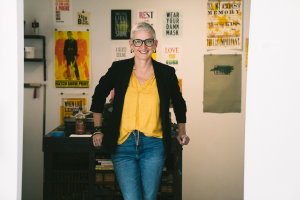
Full-body portrait of a person with short gray hair and glasses, wearing a yellow top, black blazer, and jeans, standing with hands resting on a table in a studio with colorful posters on the wall.
What does receiving an unrestricted grant at this particular moment make possible within your practice? Has it shifted the way you are thinking, working, or planning for what comes next?
As an artist who is also an educator, curator, space creator, and advocate it is rare for the ‘artist’ part of my practice to receive recognition and support. As a printmaker I create almost everyday – conceiving, drawing, carving, printing, activating, and sharing. But that work is the quietest part of my cultural work. So, first and foremost to be given a grant to sustain my personal creative efforts is big for me. It is providing the permission – or more accurately, the expectation – that creating in my studio and pushing the work out into the world is a priority in the coming months. I have a journal filled with sketches, ideas, and new research that will expand on a recent body of work that needs more attention and I can’t wait. This summer is go time!
How is your practice responding to, reflecting, or pushing against the current cultural and political moment?
My practice is steeped in this socio-political moment. Working as an artist/activist and a holder of an art and social justice space, Yellow House, in Jacksonville, FL is not for the faint of heart. My relief and letterpress prints address issues of racism, climate justice, LGBTQIA rights, and directly call out corrupt leaders, the genocide in Gaza, and the militarization of our neighborhoods. And because my art and literally my body are engaged in direct action, there is a sense of urgency to speak truth and to continue creating while I support other artists doing the same. My latest work also addresses my role in interrupting the legacy of my ancestors who perpetuated harm across many generations to Indigenous and Black communities. It is a moment with the personal is political and the political should be very personal. This is real on an epic level as I navigate being the target of state censorship, having been removed from my classroom where I teach AP Art History at a public arts high school. Using art to document, process, and shine a light on the attempt to silence me and my determination to stand in the storm for all the artists and educators I know is a privilege. To educate about the past, elevate the current moment, and project the possibility of a more beautiful and equitable future is the heart of ‘my why’. To have been selected to be part of the ThreeWalls family at such a time has provided fuel and affirmation.
Collective care is central to Threewalls’s work. How does that idea take shape in your own practice or community right now, and what are you hoping to build, sustain, or imagine moving forward?
This aspect of Threewall’s mission has always moved me and has certainly fed my own understanding of collective care. Art for me is a reciprocation, between individuals, across borders of difference, and as a gift that can be exchanged within an economy based on wisdom, creativity, and radical love. As an artist and through the community I hold at Yellow House, mutual aid is not an appendage, but is the heartbeat of how we find each other and do right by each other. I believe this is the antidote and I want the wholeness of my practice – as artist, neighbor, curator, educator, activist, and dreamer – to be rooted even more deeply in and for, community. Art and those who create will save us – together we are an unstoppable liberatory force.


Leave A Comment