

Carol Zou Interview
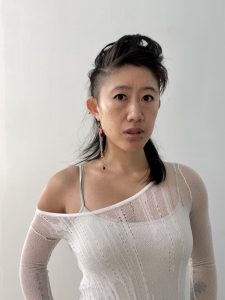
Portrait of a person with partially shaved sides and longer dark hair swept to one side, wearing a sheer white off-the-shoulder top and long dangling earrings, looking directly at the camera against a plain white background.
What does receiving an unrestricted grant at this particular moment make possible within your practice? Has it shifted the way you are thinking, working, or planning for what comes next?
It is a difficult time for the arts right now. Many of my colleagues and beloved institutions have lost income. I have been impacted as an arts worker who relies on grants, commissions, and teaching for income. Upon receiving this grant, I was surprised at how much stress I had been carrying about the arts funding landscape, and the amount of mental and emotional relief that this grant offered me. As an artist, I spend a certain amount of my time prospecting for income and administrating my practice, and receiving an unrestricted grant at this moment allows me to devote that time and energy to what really matters: my artistic and social contributions. I am able to pursue experimental projects that haven’t and don’t currently fit within an increasingly scarce and conservative funding landscape.
How is your practice responding to, reflecting, or pushing against the current cultural and political moment?
As an artist working in social practice for the past 15 years, I have witnessed the world become increasingly anti-social. This is manifest in collective trauma from COVID lockdowns; to polarization on the subjects of gender, race, and nationality; to the rise of AI as a mediator of human interaction and output. My practice critically looks at these different facets of our current social, political, and economic landscape, and posits that we need to restore a sense of relationality in order to repair our collective humanity. My social practice work uplifts the humanity of communities left out of White, Western definitions of the human, and affirms art as one of the fundamental ways that we build our understanding of humanity and sociality.
Collective care is central to Threewalls’s work. How does that idea take shape in your own practice or community right now, and what are you hoping to build, sustain, or imagine moving forward?
Collective care currently demands a deep, fierce commitment to protecting the most vulnerable amongst us. I am hoping to lean into networks of deep interdependence, and I think that is difficult to build when we are used to shallow relationships based on pleasantries or transactions. Part of that also means letting people know when I am vulnerable and need support. For that, I am so grateful for the support and relief provided by this fellowship.


Leave A Comment